Pages

Showing posts with label campsites. Show all posts

Inception, Part 1: Daegwan-Ryeong Recreational Forest


The following is Part 1 in a 2-part series about my trip to Daegwan-Ryeong (대관령) and Seonja-Ryeong (선자령) on 29-30 May 2010. In this installment, I review our campsite at Daegwan-Ryeong Recreational Forest (대관령국립자연휴양림). Please see related post (Part 2: Windmills Oh My!) for additional photos and comments.


This is where it started, where the idea for this blog was first implanted and immediately crystalized in my head. Korea's backcountry, I had to get the word out, an opportunity to experience perfection. But when I finally got around to launching the blog a month later, I hesitated in posting about the trip and continued to delay until now, an additional month later, working through various drafts of text (should it be "under impossibly blue skies" or "under skies of impossible blue" or even "azure"?) and editing the photos so I could get it just right, do it proper justice. But ultimately, I realized that whatever I write and whatever images I present could hardly convey the mind-blowing majesty of what I had witnessed on that fateful five-hour trek along the Seonja-Ryeong mountain range. You'll just have to take my word for it that it was perfect.

Friday afternoon (May 29), on route to the campsite at Daegwan-Ryeong National Forest Park, MtG and I drive through the thickest fog I've ever seen in my life. We're simultaneously fascinated by the weather and bummed by the prospect of camping tonight and trekking the following day under such conditions. Had I anticipated the extraordinary events that would soon transpire, I wouldn't have risked our lives by pulling what is probably the dumbest driving-related stunt I've ever attempted. On-coming traffic visible only 15 meters ahead, a flash before it passes by, along a winding mountain road that'd be treacherous on the clearest of days, I shoot driver's-eye view video with my iPhone, one hand on the wheel. On the clip, in between yelps of surprise whenever a car in the opposite lane suddenly leaps out of the fog, I can be heard pondering the aftermath of our dying in an accident as a result of this maneuver, leaving behind footage of the moment of impact, something that would surely be a sensation on the internet.


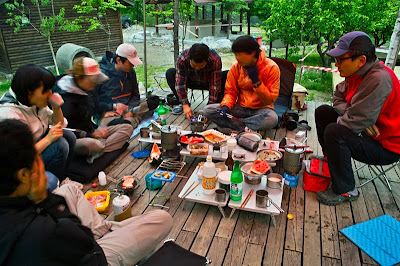
Upon our arrival, alive, we're welcomed by the other members of Backcountry Camping (BC), most of whom arrived the day before. My second trip with BC, here I meet for the first time a number of members who would form a core group (unofficially) within the organization and become friends on the outside. By evening's end, after making merry under a single tarp in the center of the campsite, sharing and indulging in 13 varieties of food and 9 varieties of alcoholic drinks, I give up any aspirations of "solo camping" and accept that camping in Korea, like most activities here, is a communal affair, for better or for worse.


TO BE CONTINUED...


Full House, Part 1: Shin-Do Beach


The following is Part 1 of a 2-part series about my trip with friends and family to the island of Shin-Do (신도) in the Yellow Sea, just off the west coast by Incheon, from 16 (Sat) - 17 (Sat) October 2010. In this installment, I review our campsite on the southern beach. Please see a related post (Part 2: Kites and Sand Castles) for additional photos and comments.


Things to Do: on the same beach, literally within a stone's throw of the campsite, is the house featured in the Korean mini-series Full House, starring Rain--5,000 won per person for 2 hrs of access--all day long, tourists came and went, many paying for the access, most appearing to be Japanese, some even taking photos of our set-up; swimming in the ocean, though the beach is more mud than sand; fishing (judging by the occasional fisherman, though I never saw anyone catch anything); cycling around the adjoining islands, connected by bridges--bicycles are available for rent at the dock (some of our team went cycling with our own bikes on day 2, though I remained behind to look after my kid).


Getting There: sammok port (삼목선착장) is located near Incheon, about 80 km from central Seoul; no public transportation available; ferry departs for Shin-Do every hour starting at 08:10, ending at 19:10--20,000 won per car, 1,800 won per person; ferry ride is 20 minutes; from dock, 5 km to beach.


Type of Site: public beach.

Grounds: sand; shade coverage under tress towards rear.

Environment: beach.


Predators: fart bugs and pincher bugs, some mosquitoes.

Capacity: up to 6 families in car camping mode in the prime locations adjacent to the parking lot and within the tree line, though the entire beach could accommodate virtually a limitless number of groups.


Fees: free; no reservations, first-come basis--get there early as possible (after taking the 2nd ferry at 09:10, we arrived at the beach at around 10AM, first ones there, so we had our choice of where to set up, but day trippers started arriving immediately thereafter).

Restrooms: separate mens' and womens' facilities with seated toilets; toilet paper provided; clean.

Showers: outdoor, cold water.

Water: 8-tap sink for general washing and cooking purposes.

Supplies: small store on-site selling snacks, instant foods, beverages; another store located in a resort on the other side of the beach.

Electricity: single outlet in the restroom, but too far from campsite to be of practical use.

Communications: moderate signals for mobile phones and 3G network; no wi-fi signal detected.

Contact Info: none.

Staff: none (though Full House house has staff until 6PM).

TO BE CONTINUED...

Black Ops, Part 1: Yongdae Recreational Forest


The following is Part 1 of a 2-part series about my trip to the Inje (인제) region near Mt. Seorak (설악산) from 22(Fri)-23(Sat) October 2010. In this installment, I discuss the campsite at Yongdae Recreational Forest. Please see related post (Part 2: Mt. Seorak National Park) for additional photos and comments.


Things to Do: as a "recreational forest" (휴양림), the site doesn't offer any activities per se; shallow stream running through the park may offer splashing opportunities during warmer weather; farmer's market about 4 km from entrance, as well as numerous roadside stores along the way, sells various dried seafood (e.g., pollack, squid) caught in nearby East Sea.


Getting There: Gangwon-Do, Inje-Gun, Buk-Myeon, Yongdae-Ri, San 262-1 (강원도 인제군 북면 용대리 산262-1); about 170 km from central Seoul; no public transportation available.

Man-made waterfall

Type of Site: public recreational forest park.


Grounds: dirt; minimal shade coverage under trees; 15 wood decks.

Environment: forest.

Predators: none.

Capacity: in addition to the 15 decks, which may accommodate up to 30 solo campers if shared, grounds offer space for perhaps 60 more, maybe 10-15 families in auto camping mode; park also has structured lodgings in other areas (I had no time to investigate).

Fees: 10,000 won per person; no reservations, first-come basis.

Restrooms: separate mens' and womens' facilities with seated toilets; no toilet paper provided; not very well maintained.


Showers: none.

Water: small 4-tap sink for general washing and cooking purposes.


Supplies: none sold on site; nearest store about 3-km drive.

Electricity: single outlet in the restroom, but too far from campsite to be of practical use.

Communications: moderate signals for mobile phones and 3G network; no wi-fi signal detected.

Contact Info: 033-462-5031.

Staff: in ticket office at entrance.


Due to its remote and isolated location, Yondae Recreational Forest provides a quiet escape from the crowds. We didn't spot another soul during our 2-night stay. But that's about all it has to offer. Our decision to set up there was based solely on our plans to explore the nearby Mt. Seorak National Park, and even that was a 5-km drive away. I highly doubt that I'll ever return, unless another specific reason takes me to the area.

THE END

Mysterious Ways, Part 4: Naribunji


The following is Part 4 of a 6-part series about my trip to the islands of Ulleung-Do (울릉도) and Dok-Do (독도) from 20(Fri)-22(Sun) August 2010. In this installment, I review our campsite at Naribunji (나리분지) on Ulleung-Do. Please see related posts (Part 1: Ulleung-Do Awaits; Part 2: Dok-Do Is Our Land--Don't Fuck With It; Part 3: Sundown; Part 5: Over the Mountain and Through the Fields; Part 6: Why) for additional photos and comments.


Things to Do: situated at the base of Ulleung-Do's central peak, Seong-In-Bong (성인봉), the trail entrance leading to the top of the mountain is within 20-min walking distance.

Seong-In-Bong to the right, Naribunji to the left

Getting There: upon arrival at the port of Dong-Do (동도) via boat from the mainland, the only practical means of access are by taxi or car rental (about 40-min drive time), both of which are available at the dock; although the island isn't that big, most destinations require taking a circuitous route along the coastal roads.

From left (circled in purple): Naribunji (top center), Dodong Port (bottom right);

Type of Site: public recreational park.

Grounds: grassy with shade coverage under trees in select areas; a handful of scattered decks.


Environment: rural.

Predators: a variety of insects but nothing predatory, not even flies.

Capacity: depending on the method of camping, the site is either spacious (enough for at least 200 solo campers) or moderate (enough for maybe 30 families of 4 in car camping mode); from what I saw this weekend (a church retreat of 20 adults and children, a few teams of locals on daytrips, a single group of car campers, and us), and based on common sense, I can't imagine that it would ever fill to capacity.


Fees: free, no reservations or advance notice required.

Restrooms: separate mens' and womens' facilities with squatter toilets; no toilet paper provided; clean but not immaculate.


Showers: 3 stalls, 1 for men and 2 for women; ice-cold water.


Water: small 8-tap sink for general washing and cooking purposes (a bigger, newer structure with additional taps was onsite, as shown in top photo, but, for unknown reasons, didn't have running water).


Supplies: restaurant within 5-min walk sells cold beverages and alcohol and cigarettes.

Electricity: single outlet in the otherwise nonfunctioning sink structure.

Communications: moderate signals for mobile phones and 3G network; no wi-fi signal detected.

Staff: none.

Contact Information: none.

While Ulleung-Do offers several options for accommodations (hundreds of home stays (minbak) and dozens of small hotels, as well as a few fancier resorts), this is obviously the way to go if you have camping gear and a means of getting to the site. On any extended trip lasting 2 days or more, you'll probably need to rent a car or make some kind of arrangement with a taxi service anyway (buses do run through the island but sporadically and in limited range), so you may as well save some money by camping. It's central location is also convenient if hiking and trekking are part of your itinerary.

Eyeing visitors getting off the boat at Dodong,
a woman offers homestay (minbak),
the cheapest though probably least predictable type of accommodation


TO BE CONTINUED...