Pages

Showing posts with label trekking. Show all posts

Arc'Teryx Shells

In connection with my previous post, in which I discussed the prevalence of Montura brand when it comes to pants among the members of the Backcountry Camping group, I discuss here the popularity of Arc'Teryx as outerwear. This composite image consists of photos taken on the same trip, a trekking excursion to the Inje region of Gangwon-Do. Five of the 17 members wore Arc'Teryx shells that day, including me. Mine, a Sidewinder SV, is shown on the bottom with the logo along the sleeve.

Of course, Arc'Teryx was also present in the form of layering tops and accessories, as well as packs, and at least one pair of pants (whereas Arc'Teryx pants are mostly loose-fitting, Korean climbers currently prefer slim or tight-fitting pants, such as those made by Montura).

Arc'Teryx hails from Canada, much of it still produced in Canada. Although I'd never heard of it prior to my involvement with outdoor activities in Korea, the label is relatively mainstream here, where it has its own retail outlets and can be found in most camping/hiking multi-shops and general department stores. From its availability in American websites, I'm assuming that it's also popular in the States.

Not cheap, especially here in Korea due to shipping costs, import taxes, and high "premium" markups (probably the biggest culprit). My Sidewinder SV is listed at 1,050,000 won, though I paid 700,000 by offering cash on a two-year-old model languishing in the back of a small independent dealer (large sizes don't sell very well, apparently). I also have an Alpha SL, 590,000 won. The most expensive model is the Alpha SV at 1,139,000 won.

Me, wearing Arc'Teryx on top, Montura below
(photo: courtesy of Lee Hosup)

Unlike the Montura pant, which I firmly believe is far superior in terms of design and quality to others that I've worn, and which fits my body particularly well, I have to confess that I can't define a specific justification for wearing Arc'Teryx shells. They feature waterproof Gore-Tex fabric and immaculate construction, yes, but so do any number of jackets by most companies these days. They look great, yes, but most styles these days are more or less the same. It can't be a matter of value, since they're overpriced. It can't be a matter of exclusivity, since they're commonplace (among outdoor enthusiasts who are willing to pay for it). I don't know, maybe it's the quirky name or the funky logo.

Montura Pants

On a recent trekking excursion to the Inje region in Gangwon-Do, I took notice that the brand Montura was the overwhelmingly popular choice for the pants worn by the members of our group that day. Organized by Backcountry Camping, the group comprised 16 men and women, 7 of whom were sporting Montura pants. Mine are in the far left of the frame. The brand was also represented in the form of top layers and accessories, such as buffs and gloves and even gaiters.

Prior to my involvement with Backcountry Camping, I had never heard of Montura. It's a small Italian brand that, as far as I'm aware, doesn't have much of a presence in the United States or anywhere in the world outside of isolated pockets in Europe and Asia, particularly Korea, where it has rabid cult followings. Even in Korea, Montura doesn't have its own store but sells mostly through small specialty stores that buy directly from the local importer, a company rumored to consist of 4 employees and generate yearly gross sales of $10 million. I'm generally loathe to follow trends--in fact, I tend to avoid them--but I have to admit that the prevalence of the tetra-petaled flower logo on the legs of so many of my camping cohorts piqued my interest.

The trend factor aside, the bottom line is that Montura makes an excellent pant. I could go on at length about fabric and construction, both of which are top of the line. Or about design esthetics, which is admittedly a subjective matter but, speaking as objectively as possible, the lines create a slimming effect on the wearer. But the main thing is that the pants are comfortable. For me especially, I appreciate the low-cut front, which stops just below, and thus doesn't interfere with, my protruding gut. I've worn Montura pants on long treks and mountain hikes, for several consecutive days on extended camping trips, around the city, and lounging at home--and never once on those occasions have I ever given a second thought to what I was wearing on my legs, a testament to the second-skin nature of the pants.

They're not cheap, ranging from about 250,000 won for a lightweight casual pair to nearly 500,000 for an extreme winter weather model. Worth it.

I have 4 pairs. I love every one of them.

Inception, Part 2: A Whole New World


The following is Part 2 in a 2-part series about my trip to Daegwan-Ryeong (대관령) and Seonja-Ryeong (선자령) on 29-30 May 2010. In this installment, I discuss our trek along the Seonja-Ryeong mountain range on the afternoon of the 30th. I've intentionally kept the text to a minimum so as to allow the images to do most of the talking. Please see related post (Part 1: Daegwan-Ryeong Recreational Forest) for additional photos and comments.


After packing up basecamp, we drive a few kilometers down the highway to the Daegwan-Ryeong rest stop. From such inauspicious beginnings, we begin our hike, first to the peak of Daegwan-Ryeong. At this point, I have no reason to suspect anything.


About an hour later, we summit. An hour, which should suggest that "summiting" is hardly the appropriate word, but, nevertheless, we reached the top, so summit we did. While the view is nice, it's predictable. The picture that would have flashed through my head if someone had said, "Imagine, from the top of a small mountain, what the view of a small city and some scattered fields of farmland in the distance might look like...," that's exactly what it looked like. Thus, I still have no reason to suspect anything.


But then, we continue down the other side of the mountain, and then it hits. I'm suddenly thrust into a whole new world, like something out of a dream or a science fiction movie. Windmills are everywhere, above, below, ahead, behind, all around, endlessly beyond the horizons. We can touch them. The vanes SWOOOOOOOSHING directly on top of us, they turn with amazing speed but even more amazingly appear to move in slow motion because of their immensity, as if the mind can't accept the fact that something so big could move that fast. We can feel their energy.


Eating lunch, sitting on the grassy hillside, under the shade of a windmill, overlooking the valley, I am inspired t0 play the title track from The Sound of Music. I think it's a genius selection, but, sadly, no one else seems to get it. (Although they were surely familiar with the song itself, the melody, I now realize that they probably had no idea that the lyrics concerned hills and being alive and sounds and music and songs and and singing and thousands of years.)


As promised above, I'll cut the commentary short. I'll just say that it was a life-altering experience, and leave it at that.


After nearly five hours of what the others in the group referred to as "Teletubby Trekking" (personally, I didn't get the reference, never having seen the Teletubbies), deliberately avoiding roads so as to maintain the illusion of otherworldliness, but staying more or less on a northerly heading (aided by our iPhone GPS, natch), we eventually reconnect with civilization when we stumble upon the Samyang Dairy Ranch, entirely by coincidence. Talk about otherwordliness, they have ostriches.


We had to call for a convoy of taxis to pick us up at the ranch and take us back to our cars at the rest stop where we'd begun this 6-hour odyssey: 4 hours of walking, 1 hour for lunch, and a total of 1 hour for multiple breaks. Later, we estimated that the trek spanned a distance in excess of 20 kilometers, perhaps significantly more considering our trajectory was neither straight nor level (but none of us knew how to factor in those additional variables).

Finally, just to keep things interesting ex post facto, we ended up having dinner together at a restaurant specializing in raw beef--not the classic Korean dish known as yukhoe (육회), which consists of sliced raw beef and pears and raw egg yolk and garlic and onions and scallions and sesame oil and soy sauce and pepper--but just raw beef, dipped in salt. At that point, in contrast to the magnificence we'd witnessed earlier that day, everything else seemed... mundane.


THE END

Black Ops, Part 2: Mt. Seorak National Park


The following is Part 2 of a 2-part series about my trip with Backcountry Camping to the Inje (인제) region near Mt. Seorak (설악산) from 22(Fri)-23(Sat) October 2010. In this installment, I discuss our trek through the Mt. Seorak National Park on day 2. Please see related post (Part 1: Yongdae Recreational Forest) for additional photos and comments.

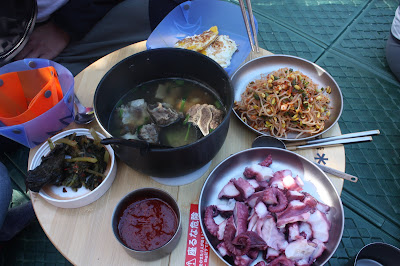
Clockwise from bottom right:
parboiled octopus, red chili paste (dipping sauce for octopus),
marinated perilla leaves and radish sprout kimchi, galbi tang (갈비탕) (beef rib soup),
fried eggs, marinated bean sprouts.

Following breakfast, we set out for Mt. Seorak National Park, a 5-km drive from base camp. In the announcement for this trip on the Backcountry Camping website, the description of the planned activities was cryptically vague, noting only that we would be trekking, the destination to be revealed upon arrival. That morning, daypacks all ready to go, our leader explains that Mt. Seorak National Park is off-limits to the public. If caught, though he notes that the chances of this are highly unlikely, as the park doesn't have patrolling authorities, each person faces a fine of 500,000 won. Despite the risk, nobody backs out.

Still legit, crossing a stream on the way to the park entrance.

Still legit, just prior to the entrance,
an obstacle course built by the Korean military for training purposes;
this will come back into play later (see below).

A sign at the park entrance warning would-be explorers about the penalty for venturing in;
we've just crossed the line into illegality.

The first hour is unremarkable. Although our primary objective, and reason for breaking the law, is to view the autumn foliage in its untouched glory, we find that much of the leaves have yet to turn and those that have are already fallen to the ground, rendering the trees bare and the scenery somewhat bleak.


Like something out of a children's fairy tale, or maybe a horror movie, we encounter a mysterious house in the middle of the woods. Crossing a small bridge, we explore. Although no one is around at the moment, the house shows obvious signs of residence. We wonder, first, how the inhabitants are allowed to live in an otherwise restricted area, though we suspect that they sustain themselves by collecting and selling wild herbs and medicinal plants. Second, we are amazed that they manage to lug packaged foods (e.g., ramyun), beverages (e.g., canned beer), and other sundries (e.g., shampoo) through the forest, up the hills, and across the streams.


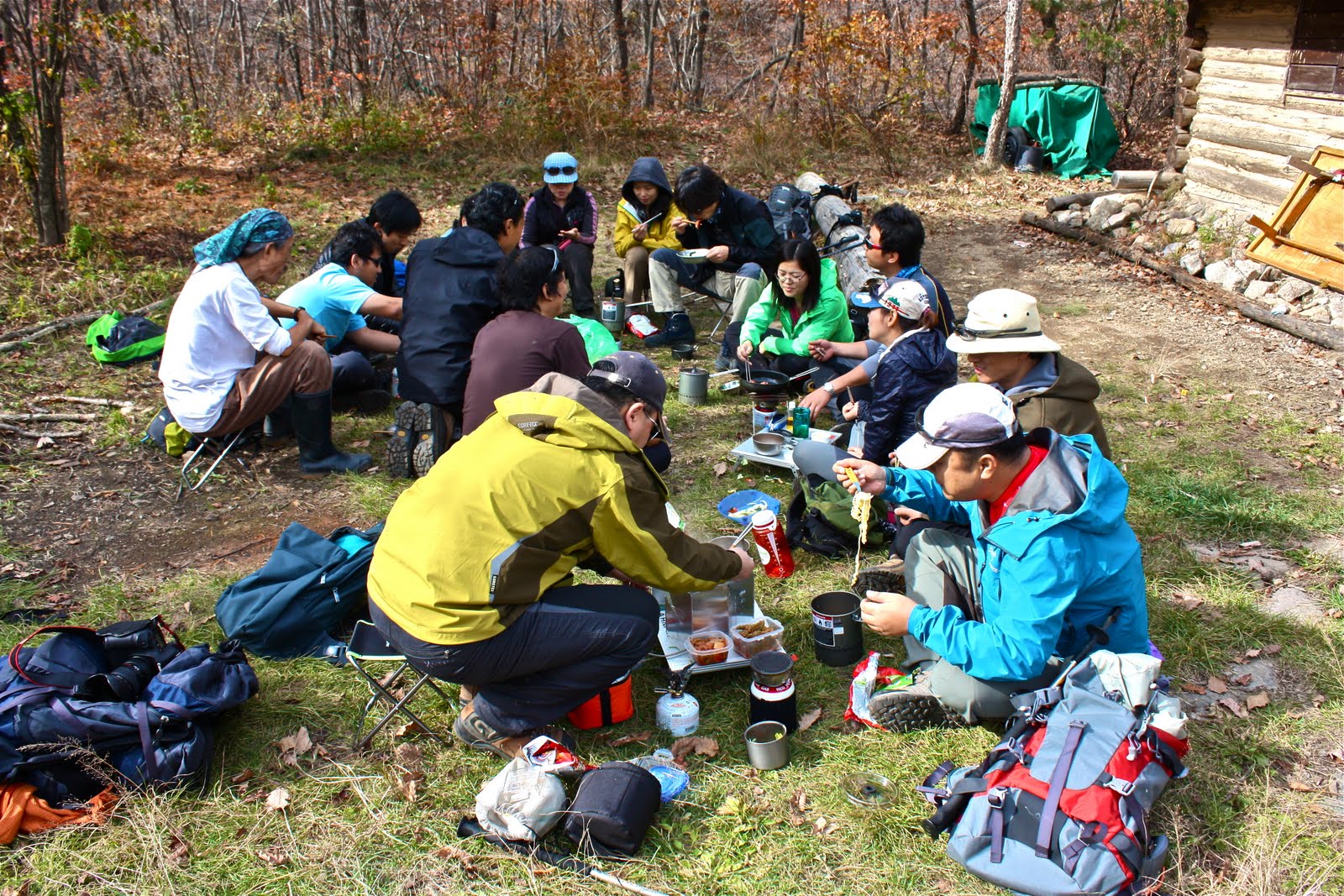
A few kilometers later, we discover yet another habitation, an actual log cabin in a clearing, surrounded by mountains. With the midday sun shining brightly overhead, the skies richly blue, the foliage on the trees in the distant mountains is much more impressive. We settle here for lunch. During our preparations, an old man appears out of nowhere, the owner of the cabin. Adding to the improbability of the situation, he's carrying a long tree branch for a cane and burlap sack slung over his shoulder. He has a beard. I'm surprised that he's wearing shoes, this storybook old man of the hills. At first, he's a bit put off by our invasion, but soon enough he warms up to us as we offer him food and drink. After lunch, we sprawl out for quick nap, some of us. Before we leave, the old man gives us wild mushrooms and berries. We get his cell phone number, believe it or not, and promise to return someday. And we lived happily ever after.

The cabin is equipped with solar power,
the panels (barely) visible in far right of frame.

Old man of the hills, far left.

Salad in Italian Dressing
with Crispy Chicken and Grilled Pork.

The cabin's interior.


After our return to civilization, our group's leader proposes that we engage in a competition involving the obstacle course at the park entrance, the losers to buy sashimi for dinner. Nobody is particularly thrilled by the idea, but we go through with it anyway. As I would be leaving early that evening, returning to Seoul for personal reasons, I am taken out of the picture, ordered instead to document the high jinx for posterity. I would later make a short film of the event, which is available on YouTube at the following link: http://www.youtube.com/watch?v=lW87BqPrrM0. Enjoy.


THE END